
Referral Rewards for Miners: Reading the Terms
The headline percentage in a referral programme is the least informative part of it, because the same number means wildly different money depending on the base it applies to. At 2 PH/s, gross mining income is about $75.99 a day at a $84,692 BTC price, while the entire listed 4% block-reward fee on that output is about $3.04 a day — a 25x difference. Read the base, the asset and the activity condition before the rate.

Key takeaways
- Base first: $75.99 a day of gross income against $3.04 a day of listed 4% block-reward fee at 2 PH/s means a rate quoted on gross needs to be about 25x smaller to equal the same reward.
- Rewards follow live hashrate — 20 TH/s referred generates $0.76 a day gross and $0.03 a day of that fee, while 2 PH/s generates $75.99 and $3.04.
- Cadence is inherited from the referred miner: PPS+ settles hourly against current difficulty, PPLNS pays after 6 confirmations over the last 5 difficulty rounds.
- Tracking is the quiet failure point. A referral that is never attributed pays nothing, whatever the terms say.
The core idea
A referral reward is a claim on the fee that referred hashrate generates. That single sentence resolves most of the ambiguity in a term sheet. It tells you the base is a fee rather than a gross payout, that the reward scales with the referred miner's production rather than with their signup, and that the reward stops when the production stops.
Everything else in the terms is a condition attached to that claim: which fee component it draws from, which asset it is paid in, how long the referred miner has to stay active, what the minimum payout is, and how the referral gets attributed in the first place. A service such as ViaBTC Referral is useful to read against the fee schedule it draws from, because that is where the base becomes visible.
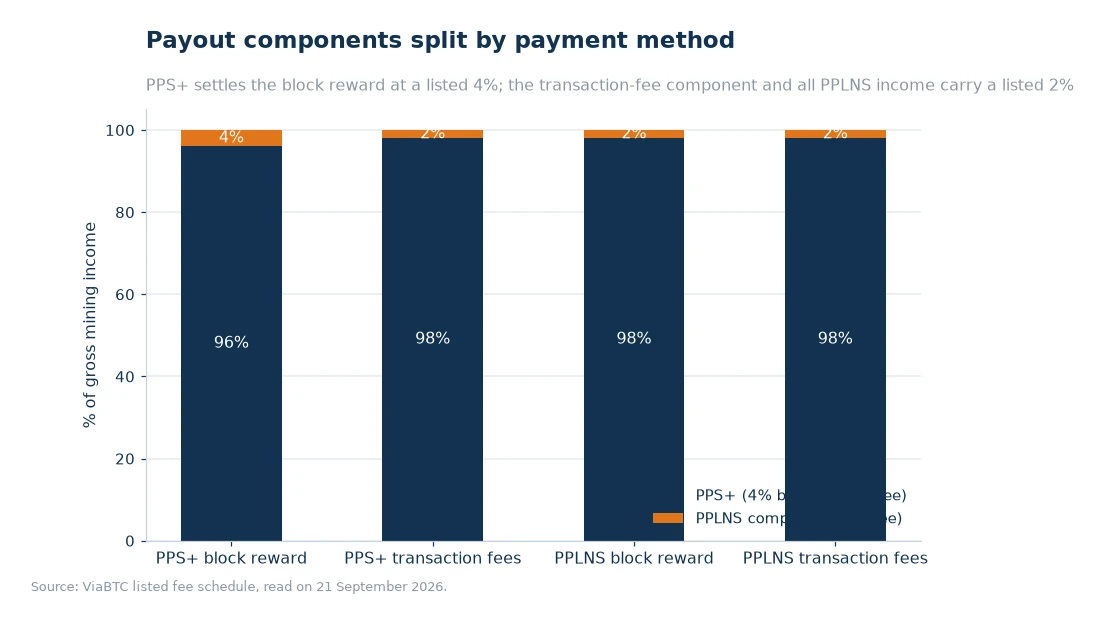
The platform's own schedule sets the components that can be referenced. PPS+ carries a listed 4% fee on the PPS-settled block reward and a listed 2% fee on the transaction-fee component; PPLNS carries a listed 2% on both components together.[1] A reward defined against one component is not the same as a reward defined against the blended total, and the gap between them is exactly the distinction worth clarifying in writing.
How it plays out at scale
Build the comparison from hashrate outward. Output per TH/s per day is about 4.486 × 10⁻⁷ BTC at difficulty 132.76 T, which is roughly $0.038 at the current price. Multiply by the referred hashrate, then apply the fee component the terms name.
| Term to check | The number that decides it | Why it matters |
|---|---|---|
| Reward base: fee or gross | $3.04 a day of listed 4% fee against $75.99 a day of gross at 2 PH/s | A rate expressed on gross has to be about 25x smaller to equal the same money |
| Payout asset | 20+ supported coins including BTC, BCH, LTC with merged DOGE, KAS, ZEC, HNS, CKB and ETC | The asset decides how many conversion steps sit between reward and spendable funds |
| Activity condition | PPS+ hourly settlement versus PPLNS after 6 confirmations across 5 difficulty rounds | Reward cadence follows the referred miner's cadence, including its gaps |
| Tracking method | Referral link, code or app install on iOS or Android | An unattributed referral pays nothing, regardless of the rate |
| Duration and threshold | $0.15 a day of fee at 100 TH/s versus $15.20 at 10 PH/s | Small referrals take a long time to clear any minimum payout |
Note how the last row changes the practical advice. A programme with an attractive share and a high minimum payout can leave a referrer with a balance they cannot collect for months if the referred hashrate is small. The same terms are comfortable when the referred hashrate is industrial.
Two scenarios compared
Five small referrals. Five operators at 20 TH/s each add up to 100 TH/s. Gross income is $3.80 a day, the listed 4% block-reward fee is about $0.15 a day, and that fee is worth $4.56 over 30 days. If the terms include a minimum payout, the practical question becomes how many months of that fee it takes to reach it.
One industrial referral. A single 2 PH/s fleet generates $75.99 a day gross and about $3.04 a day of the same listed fee — roughly $91.18 over 30 days. Twenty times the hashrate, twenty times the fee, and one relationship instead of five to keep track of.
Neither scenario is inherently better, but they fail differently. The small-referral book needs volume and time to produce anything; the large-referral book produces immediately and stops entirely if that one miner leaves. Both are worth monitoring with the same tools you use for your own machines: the mining app shows real-time hashrate with alerts and multi-account management, which is the quickest way to see a referred account go quiet.
Then confirm where the reward lands. If the programme pays in a coin you do not otherwise hold, plan the conversion rather than leaving it to chance, and prefer an account structure where mining income, rewards and conversions sit together — the same reasoning that makes a mining pool account with an integrated wallet easier to reconcile at month end.
Common failure modes
- Reading the rate first. A percentage attached to the wrong base is misleading even when it is disclosed. Identify the base before comparing anything.
- Assuming attribution is automatic. Links, codes and app installs are separate tracking paths, and a referral that is not attributed is not a referral.
- Treating the reward as passive. It is proportional to live hashrate. When the referred miner throttles, switches pools or shuts down, the reward line moves with them.
- Ignoring the asset. A reward paid in an asset you convert immediately creates a second transaction to track, and conversions belong in the records.
- Forgetting the fee mechanics underneath. The referral cannot outlive the fee it is funded from, so understanding the 4% and 2% components is the same skill as reading the referral terms.
Frequently asked questions
Does the payout method change my average income?
It changes the variance and the fee, not the underlying expected value: your share of network hashrate still sets the ceiling.
How often should a miner check pool statistics?
Weekly is enough for cash flow, daily if you are reconciling worker uptime or chasing a hashrate fault.
Which term matters most in a referral programme?
The base. At 2 PH/s the gap between a reward quoted on gross income ($75.99 a day) and one quoted on the listed 4% block-reward fee ($3.04 a day) is a factor of about 25, which is larger than any difference in advertised share.
Read the terms backwards
Start from the fee the referred hashrate generates, then work outward: which component the reward is drawn from, what asset it is paid in, what keeps it alive, and how it is tracked. A programme that answers those four questions clearly is comparable with any other; one that only publishes a percentage is not. Write the arithmetic down before you promote anything, and review it when difficulty moves.
Data and sources: ViaBTC listed fee schedule[1], referral terms and app documentation[2][3]. Network difficulty (132.76 T), network hashrate (about 1,003 EH/s) and the BTC price of $84,692 were read from public chain data and market feeds on 21 September 2026. Figures are arithmetic on those inputs, change with difficulty and price, and are not a promise of earnings.